Living With Doubt

For much of my adult life, I have lived with the dilemma of doubt. I’ve often wondered, Are doubt and faith mutually exclusive, or can they coexist? What is the relationship between the two extremes?

My favourite biblical character is the disciple of Jesus familiarly known as Doubting Thomas.

When the other disciples told Thomas they had seen their leader following his resurrection, Thomas refused to believe unless he had both visual and tactile proof.

Thomas often gets a bad rap for his rank skepticism, but perhaps he can be rehabilitated and serve as an ideal traveling partner on the rocky pathway of life.

In 1985, I wrote one of my former Religious Studies professors at Memorial University, the late great Dr. R. Sheldon MacKenzie, about my raging battle with persistent doubt.

His response set the issue in context for me.

“Burton,” he said, “we must not be afraid of our doubts…. The opposite of faith is unbelief, a different thing entirely. And it is by our doubts that we grow.”

He then told me that “the ONLY member of my class in theological college who later gave up his ordination was the only man who never had a doubt about anything.”

My personal experience has been that doubt can have a truly positive character, as it is an integral part of living, growing and maturing.

The writer of the Book of Proverbs states, “A simple man believes anything.”

The person who responds to an answer with more questions receives the greatest amount of knowledge.

I suggest God does not despise the honesty which detains the doubter from saying “I believe” until he is able to believe truly.

Being fearful to believe demands a willingness to take a risk, a leap of faith.

A doubting believer is not an oxymoron.

To say it is, leads to anxiety and bondage in the doubter. Unbelief is an intellectual refusal to believe, whereas doubt is a suspension of decision.

Back to my mentor-friend, Dr. MacKenzie, “We encourage people through their doubting periods, but we would not want them to stop asking deep questions of their faith. That would be to produce the most unlovely kind of Christians. There are too many people who have the answers to everything. They help only a few who refuse to do any thinking for themselves.”

As for how to deal with doubt, acknowledge it and admit you want it resolved. Candidly and honestly share it with a nonjudgmental person. Seek advise.

If, after counsel and personal meditation, you are able to determine the source of your doubt, deal directly with it.

Have I resolved all of my doubts, even after more than three decades as a clergyman?

Not by a long shot. Some doubts may never be adequately dealt with. Perhaps there is something to the title of one of Rev. Leslie D. Weatherhead’s books, The Christian Agnostic.

Meanwhile, while continuing to live with the dilemma of doubt, I draw encouragement from Doubting Thomas who, in the end, became an example of newfound faith by declaring “My Lord and my God!”


A Recipe for Disaster

Jiggs dinnerI enjoy Jiggs dinner. Having said this, I realize this delicacy means different things to different people.

In many places, it typically consists of salt beef (or riblets), boiled potatoes, carrots, cabbage, turnip, turnip greens (in season), bread pudding, dressing, pease pudding, and cooked turkey, chicken or beef roast. Condiments include mustard pickles (preferably homemade), bottled beets, cranberry sauce and butter.

That, to me, is a cooked Sunday dinner.

My Jiggs dinner is made up of salt beef, potatoes, carrots, cabbage, turnip, parsnip, brussel sprouts and pease pudding. That’s it. Nothing more, nothing less. Though a diabetic, I “mang” together this occasional ambrosial delight.

Which recently brought Mart to my mind.

He married Belinda from Western Canada. Sherry and I got to know them well while we were stationed in western Newfoundland.

Mart was a prime example of the adage, “You can take the boy out of the bay, but you can’t take the bay out of the boy.”

An accomplished cook, Belinda regularly regaled Mart’s tastebuds with a variety of dishes. As tasty as her cooking was, though, he missed certain dishes he had been raised on, especially Jiggs dinner.

“What would you like me to cook?” Belinda asked Mart repeatedly.

The answer was always the same: “Fish ’n brewis and Jiggs dinner.”

“But I don’t know how to make either,” Belinda said. “Do you have a preference?”

“Yes. Jiggs dinner! Man, I can taste it now! Easy as 1-2-3, too! Just boil the salt meat till it’s tender, drop in the vegetables, and cook it.”

So Belinda made covert plans to surprise Mart.

She gathered the ingredients for Jiggs dinner. For starters, she bought a tub of salt meat. At home, she dropped the meat into a large pot of water and boiled it for several hours. When the meat was tender, she added peeled vegetables. She boiled the mixture till everything was cooked.

She set the kitchen table with her china and best cutlery, then brought out candles, in readiness for the special feast.

Mart arrived home from work, dirty, tired and famished. Even before he opened their apartment door, he smelled the unmistakable odour of Jiggs dinner. Naw, can’t be, he thought. I must be daydreaming. Belinda couldn’t. But she could.

Flinging open the door, Mart was met by Belinda, a broad smile on her face. The lights had been extinguished, replaced by glowing candles on the table.

“Guess what?” Belinda said.

Playing along, Mart said, “What?”

“I cooked your favourite meal!”

“You did? Which one?”

“Jiggs dinner.”

“God love you, my darling!” He planted a kiss on her lips.

After a shower, Mart returned to the kitchen.

“Sit down,” Belinda instructed.

She removed the pot lid. Now, the smell was overpowering.

Mart watched as Belinda dug into the pot and lifted out their meal. His helping was generous; hers was modest.

Mart, having flashbacks to his childhood, grabbed his fork and stabbed a chunk of salt meat. Forgetting his table manners, he jammed the morsel into his mouth.

Suddenly, he stopped, looked at Belinda, and gasped, “A glass of cold water! Quick!”

“Too hot, is it?” she inquired.

“No, too salty!”

The significance of his response eluded her. “It is salt meat, after all,” she said. “Isn’t it supposed to be salty?”

“Yes, but this is really salt. Did you soak the meat?”

“Why would I do that?”

“Belinda, you knows you gotta soak salt meat to get rid of some of the salt!”

“Oh.” Her smile had narrowed considerably.

Then Mart tasted a carrot. “Holy smokes!” he exclaimed. “Is that ever salt.”

Belinda’s smile disappeared. “You said you loved Jiggs dinner,” she said. “You gave me the recipe, which I followed in slavish detail.”

“I know, honey.”

“Mart, I actually went to the store and bought a tub of salt meat. I cooked it all afternoon.”

“Whaddaya mean…you cooked it all afternoon?”

There was an icy silence before Belinda answered.

“That’s exactly what I mean. I cooked the meat all afternoon till it was tender.”

“Out of curiosity, Belinda, exactly how much meat did you cook?”

“Whatever was in the tub.”

“All of it? You’re only supposed to cook a piece or two, after it’s soaked.”

“But you didn’t tell me.” With that, her voice broke. “I did this just for you, Mart, and I blew it. I’m sorry.”

“Honey,” he said, “I appreciate your effort. I should’ve explained the recipe better. I guess I’m so used to Jiggs dinner back home, I thought everybody knew how to cook it. Anyway, it’s the thought that counts.”

Realizing that her husband wasn’t upset but could see the humour in the situation, Belinda’s tears slowly turned to smiles, then gales of laugher.

“I can now see why the instructions you gave me were a recipe for disaster!” she said.

My Trove of Postage Stamps from Israel

Stamps from Israel - 1What follows is a Facebook exchange I had earlier this year with a former parishioner of mine, Hubert:

H: Burton, I am going to take a trip to Israel during the first week of June for nine days. My wife doesn’t want to go. Do you want to go with me if I took care of expenses and paid for your trip?

B: Are you for real? Or is this a dream?

H: No, I’m serious.

Truth be told, I really did think Hubert was “pulling my leg.” So, I thought to myself, Yes, I’ll go with you to Israel and, once we get back home, we can fly to the moon together!

However, Hubert was serious. And, as they say, the rest is history. He and I travelled to Israel, which left me with enough memories to last a lifetime.

No trip to such a country would be complete for a philatelist–i.e., a person who studies or collects postage stamps–unless and until he buys a few stamps.

I could have left my tour group and gone to a local postal outlet, I suppose, but I chose not to. Instead, a couple of days before leaving the country for home, I dropped into a shop in our hotel.

“Do you have any postage stamps?” I asked the proprietor.

I was in luck. “I’m the only store in Israel that has them!” he exclaimed and exaggerated.

I purchased a selection of stamps, some of which can be viewed in the accompanying scan.

Newfoundland: An Island Apart

Newfoundland An Island ApartI share two tenuous connections to Dennis Minty.

For one, he was born in Twillingate, where I lived as a child.

Then, his current hometown is Clarke’s Beach, where I was born and where I was employed as museum director with the town this summer.

There the personal connections end.

Minty is a celebrated photographer, while I take snaps if and when I manage to operate my daughter’s camera.

Photography has been Minty’s passion ever since he was given a Brownie camera at age twelve.

“No matter what professional career I had,” he says, “my camera was almost always with me.”

His forte is nature-based photography.

However, he was fifty before he turned his adolescent hobby into a living.

“I was always having to do other things to put bread and butter on the table,” he explains. “I didn’t want to turn eighty and never have pushed the photography envelope harder.”

His first book of Newfoundland images was Wildland Visions, published by Breakwater Books in 1993.

His most recent book is Newfoundland: An Island Apart.

“To belong to a place is a gift,” he writes in the introduction. “And I have been blessed with a profound and abiding sense of belonging to Newfoundland.”

The island informs both his photography and his life. His perennial quest has been to seek out “the island’s gems and the light that washes over them.” He has learned the light and seen the landscape’s virility.

Newfoundland: An Island Apart is a celebration in images of what this place means to him.

What does Minty hope to impart to his viewers?

In short, to “evaluate people’s consciousness; to inspire other people to appreciate the natural world in some way like I do; and to create awareness, and gain greater understanding of and appreciation for the fantastic natural world we live in.”

The photographs in Newfoundland: An Island Apart reflect a wife range of themes, from the provincial flower, a pitcher plant, to the sea crashing against the Mad Rock off the coastline of The Shoreline Heritage Trail near my hometown, Bay Roberts; from an evening of peace and tranquility in Durrell to the scenic town of Trinity; from a man following his horse on a chilly winter morning in Carbonear to The Arches of the Great Northern Peninsula.

There are more than sixty images, a veritable visual treat for the artistically weary.

As for the future of Minty the Photographer, thankfully, he plans to “continue this until I can’t move around anymore. I don’t see myself ever retiring from it.”

Newfoundland: An Island Apart is published by Breakwater Books and retails for $18.95. The ISBN is 978-1-55081-600-6.

The Not-so-“Purr”fect Visitor to Church

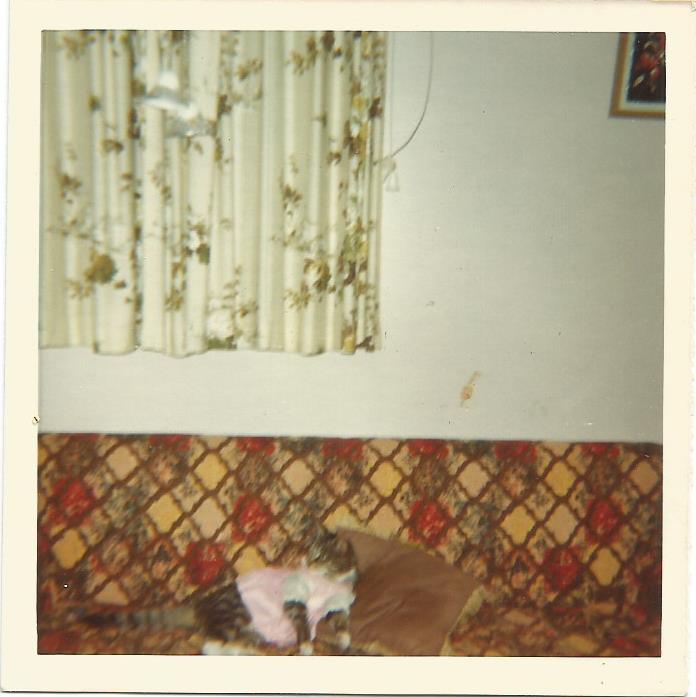
Tommy dressed in drag

Tommy dressed in drag

I miss Tommy. When I was twelve, I “owned” a cat. I named him Tommy. I’ve put the word “owned” in quotation marks because technically he wasn’t mine. There were two reasons for this.

First, my father disliked four-legged animals. He didn’t encourage his children to have pets.

Second, Tommy belonged to a neighbour. However, over a summer, I wooed him to our garden. Then, whenever Dad was away on personal or church business, I would let Tommy inside the parsonage for a few minutes, hours or days, depending on the length of my father’s absence.

By summer’s end, Tommy was, for all intents and purposes, my cat. He watched me like a hawk from his vantage point on our veranda as I left for school in the morning, and he was there when I got home in the afternoon. He found his own home at night, but he religiously came to me for food, water and caressing. I always had a ready supply of treats on hand.

In August, it was so hot in our Pentecostal church–in more ways than one, I might add–the ushers would open the windows to let in a draft of air.

One Sunday evening, after the service had swung into high gear, an usher threw open all the windows.

The church was divided into two rows of pews, with an aisle in between. My brother and I, guitar players both, sat on the second pew from the front on the left, directly below one of the windows.

No sooner had the usher opened the windows and returned to his chair at the back of the sanctuary than I caught a blur of fur out of the corner of my eye. Jerking my head in disbelief, I saw Tommy, perched on the windowsill, purring and peering around the church, obviously looking for me. I caught my breath and waited for what I knew was the inevitable. I felt blood rush to my cheeks.

Suddenly Tommy spied me. In one grand leap, he jumped over my brother and landed on my left knee. Now, I was holding both a cat and a guitar.

Dad, doing his usual thing on the platform, missed nothing in the unfolding drama. He instructed his youngest son, “Burton, put the cat out.”

Not one to publicly disobey my parents, I dutifully placed my guitar aside, knocking it against the pew, the open strings making a loud discordant sound. I marched to the back door, where I released Tommy and shooed him away from the building.

Many of the congregants had knowing smiles on their faces, while others looked like they had just swallowed a lemon. Several of the younger set, who were my schoolmates, were enjoying the incident to the full. It was more exciting than what was happening on the platform.

My face burning, I returned to my pew, gathered my musical instrument, and picked up where I had left off.

To my horror, I suddenly heard a loud meow outside. I shot a glance at my reserved mother, who was sitting across the aisle from us, then at my father on the platform, then at my brother who had a deadpan expression on his face. I instinctively knew exactly what was about to happen…again. Tommy was back with a vengeance.

A moment later, he jumped up onto the windowsill. This time, though, he knew exactly where I was sitting. He crouched, then shot through the air like a bullet from a gun. Missing the mark by a few inches, he wedged himself between my guitar and me. There was an ungodly uproar as he tried to extricate himself, while I struggled to put my instrument down and hold him tightly, to prevent him from doing a holy roller dance around the church.

I was humiliated. Not surprisingly, my friends were delighted. I could imagine them saying, Now this is what makes church exciting!

Dad shifted his glasses and pursed his lips. A man of few words, he spoke directly to me for the second time, “Put the cat out.”

His order was my command, so I followed it to the detail. I walked to the back entrance and deposited the cat outside. Despite the fact that I thought the world of Tommy, I refuse to put into print what I whispered under my breath to him as I told him to get lost.

As I was walking back to my pew, my face aflame, I heard Dad say, “Mr. Usher, please close all the windows.”

Craving Caffeine

Tim HortonsThe first thing I do each morning, as I stumble about the kitchen, is brew a cup of coffee. Then, I sit in the den and read and drink. I am man enough to admit that coffee provides me with a “kick.” (Perhaps it isn’t all that strange that, in my years of parish work, I never once preached on addictions!)

During the remainder of the day, I limit my intake of caffeine because, as a wag once put it, “If your intake exceeds your output, your upkeep will be your downfall.” I try valiantly to survive caffeine-free…unless I’m traveling.

When my wife and I are on the road, and a bright red sign–Tim Hortons Always Fresh–looms in the distance, neither of us needs much encouragement to yield. A gospel song includes the words, “Yield not to temptation, for yielding is sin.” I’ve often replaced the word sin with fun, in a vain effort to justify my penchant for caffeine. “It makes the trip go better, doesn’t it, Sherry?” I ask my much better half.

“Yes, dear.”

One night, when it was raining cats ’n dogs, we were again on the road. We had finished shopping and were in the car, headed home from a nearby town. There, ahead of us, beckoned that sign–Tim Hortons Always Fresh. Temptation strong assailed us as we imagined a loudspeaker blaring the mantra, “We have caffeine. You need caffeine. Stop for caffeine.”

“I will if you will.” At least on this issue, my wife and I are of the one mind.

“Yes, dear.”

I dutifully indicated a lefthand turn, slowed and swerved onto the Tim Hortons parking lot. There were no other customers ahead of us, so we were assured of swift service.

We coasted to a stop. I lowered my window and waited for the waitress to say enticingly, “Welcome to Tim Hortons. May I take your order please?”

I dug into my pocket for change; Sherry scrounged her purse for the “widow’s mite” to add to what I had.

No welcoming voice. No warm invitation to place our order. Rain pounded my face on this wet, cold, dank, miserable night…a night that could only be made better by the “elixir of life,” coffee.

Unusual, I thought. I spoke to my traveling partner, a modicum of frustration sounding in my voice, understood only by those who are in dire need of a caffeine fix.

“Why isn’t she speaking?” I wondered aloud. “She must know we’re here, and there aren’t any customers ahead of us. Whatever can be keeping her?”

By now, the silence was deafening, but for the rain beating on the car roof.

Suddenly, I heard a titter from Sherry. Glancing across at her, I saw a smile crease her face, then she broke into a hearty laugh.

“What’s so funny?” I asked, feeling a stronger need than ever for a medium black, sugarless coffee.

“Burton,” she said amid howls of laughter, “I don’t think she speaks from the garbage box!”

“What?”

“Look where you stopped,” she instructed. “We’re at the garbage disposal unit. Drive ahead and place your order at the speaker, like everybody else. We might get served then.”

“Yes, dear.”

I was embarrassed and humiliated. I drove ahead and placed our order…a regular for me and a decaffeinated for her. I made Sherry promise not to tell anyone of my error and, to this date, she has faithfully kept her word.

My Moscow Haven

My room in a Moscow hotel

My hotel room in Moscow

In 1978, when I was twenty-one years old, I won an all-expense-paid tour of the USSR in an essay contest sponsored by Radio Moscow and the Sputnik Youth Organization.

In Moscow, well before the advent of the greater freedoms evident in the country today, I was greeted with an incredible maze of intimidating red tape. The unbelievable hassles and confusion caused by bureaucratic foul-ups made my journey seem to me like a Marxist comedy of errors, more reminiscent of the Marx Brothers than Karl Marx!

On July 24, a day before flying to Montreal to connect with my Aeroflot jet to Russia, I left Bay Roberts and picked up my airplane ticket in St. John’s. I also visited several banks and asked to have my Canadian funds exchanged for Russian currency. I was finally informed, “Rubles aren’t legal tender on the world market.”

Five days later, in Montreal, I checked in my luggage and submitted my ticket for inspection at Mirabel International Airport. Prior to entering the waiting area, I visited a currency-exchange booth and spoke with the young man on duty, “What should I do with my money…change it into Russian currency here in Canada, or wait until I arrive in the Soviet Union?”

To my delight, he offered immediate exchange, giving me 1,000 rubles in exchange for my $312 in American Travelers’ Cheques. I was now ready to shop in style in Russia!

At 5:43 P.M., our plane taxied down the runway. My one consuming thought was, I hope there’s a Sputnik rep waiting for me in Moscow.

Almost sixteen hours later, we landed at Sheremetyevo International Airport, outside Moscow. Disembarkment was followed by the interminable hassle of visa, passport and customs inspection.

We were required to report any Russian currency in our possession. The Customs Declaration Form stated: “I have on my person and in my luggage the following: 1. Currency and currency equivalent: (a) U.S.S.R. currency _____.” I boldly recorded “1,000 Russian rubles,” then handed the form to the young female attendant.

She reviewed my statement and, expressing genuine shock, asked, “Where did you get all that money?”

“It was given to me in Montreal.”

With an incredulous stare, she inquired, “But don’t you know it’s illegal to carry Russian currency from another country into the Soviet Union?” She added calmly, “If you hadn’t reported it and it was discovered, you would’ve been eligible for an immediate ten-year prison sentence.” She called a teenager who, in turn, called an aging, bald, moody man, who made it clear that bargaining was not an option. “Pass over the money,” the female demanded.

“But please,” I appealed, “I need the money. I’m here for two weeks and, without that money, I can’t buy anything.”

Only the Canadian Embassy can help me now, I thought. After my luggage was searched in detail, I went to the nearest telephone and called the embassy. I explained my situation to the sole official on duty.

“Unfortunately,” he said, “our offices are closed for Sunday. Call back tomorrow.” What to do until then? Where’s that Sputnik rep? I wondered aloud.

Vladimir finally arrived–two hours after I did! “Sputnik is not expecting you,” he assured me bluntly. Evidently, nobody in Russia was aware of my arrival.

I showed him the letters I had received from Moscow. informing me that I had indeed won the trip. He phoned various people, but nobody knew what to do next, now that I had arrived by official invitation. Vladimir suggested that I stay in a hotel, at my expense, for the night. As I had already lost $312, I rejected his suggestion. At last, he said, “A bus driver will take you to a hotel, where you are to ask for ‘Sergei.’ He will help you.”

Forty minutes later, I entered the hotel. In an upbeat voice, I said to the receptionist, “Sergei.” She gazed laconically at me, slowly shaking her head.

I was in the fourth-largest city in the world, a city of close to seven million people, and I couldn’t make contact with anybody. I couldn’t speak Russian. On a slip of paper, I penned the Russian words for “to speak English” and passed it to the receptionist. Another blank stare.

I’ll have to contact the embassy again, I told myself. I wrote the word for “telephone” on a scrap of paper and showed it to a policeman. He disinterestedly pointed to the instrument. To my chagrin, I suddenly realized I had no rubles to make the call!

There was, I decided, no way to contact “Sergei.” I sat in the hotel lounge and thought and prayed. Moments later, I spied the bus driver who had driven me to the hotel. I quickly dug into my pocket for the embassy address. I showed it to him and, at the same time, displayed a handful of Canadian coins. Pointing to his bus, he offered to drive me to the embassy.

The embassy door at 23 Stariokonyushenny Pereulok was a welcome sight. Inside I told my story to one man, then another. It was too late to speak with the folks at Radio Moscow and I didn’t have anywhere to spent the night. A Canadian secured a hotel room for me and loaned me ten rubles.

I careened to Hotel Ukraine in a black station wagon, driven by a Russian. I jumped into bed and slept for six hours. Once awake, I became very lonely…and scared.

On Monday morning, I left the hotel and caught a cab to the embassy, where I was met by a host of friendly faces. I rehearsed my story. They made several phone calls on my behalf. Radio Moscow was adamant that I had not won the trip. “No one ever wins a trip from us!” they declared.

The first secretary and consul at the embassy read to the Russian the letters I had received from Radio Moscow.

“Who signed these letters?”

“Mrs. Maria Kolbantsev.”

“But that’s impossible. No such person works at our studious!”

At this revelation, my Canadian friend boiled over and, in language that turned the air around me blue, harshly demanded immediate action. His pressure resulted in grudging progress. I was told that later that day, I would be traveling to Leningrad to begin my tour. The Canadian Embassy had become my personal haven, my Shangri-La, my home away from home.

Since then, many What if? questions have arisen in my mind. The answer to each one goes back to the debt of appreciation I feel for the Canadian Embassy in Moscow and their personal care for me at a time when my future looked so foreboding.

Learning to Read

The Clue of the Screeching OwlBetween the ages of ten and fourteen, I cut my reading teeth on the venerable Hardy Boys mystery stories, written by Franklin W. Dixon, the pen name used by a variety of different authors.

In my mind, I can still see the front cover of Book 41, The Clue of the Screeching Owl. What a look of fear on the faces of brothers Joe and Frank Hardy! The book blurb states: “When dogs and men suddenly disappear, and strange screams fill the night, fantastic stories of vengeful ghosts are almost believable.” Dramatic captions identified the terrifying illustrations, such as: “At that moment, two venomous snakes slithered out of the cave.” Heady stuff for a repressed teenager in the late 1960s and early 1970s.

Because I was raised in a conservative home, where so-called “worldly” literature was frowned upon, I had to devise an undercover method of reading the Hardy Boys.

Every day, I would take one Hardy Boys book home from the school library. After my homework was done, I would remain on the daybed in my father’s study, hide my “worldly” book behind a scribbler, binder, or textbook larger than the novel itself, and breathlessly devour it. I continued this practice until I had read all sixty-six books in the series, then turned to Nancy Drew, followed by Tom Swift.

One night while reading, I listened with glee to a conversation between my parents.

“Eric, Burton’s a very studious boy, isn’t he?”

“Why do you say that, Aggie?” Hagar was Mom’s name, but she went by Aggie.

“Well, haven’t you noticed how he stays on the daybed and studies till bedtime every night?”

I guess Dad hadn’t noticed.

I often wonder about what Will Oxford calls “the mystery of the immortal detectives.” He says, “the primary ingredient in the Hardy recipe is adventure,” followed by “a healthy dose of mystery and intrigue.” The third ingredient is humour. The Hardy boys’ best friend, Chet Morton, can always be relied on for a hearty laugh, and Aunt Gertrude drops the occasional colourful remark. “Humour such as this gives readers a much-needed breather from the books’ breakneck pace.” Finally, the storyline follows a predictable pattern, including a brief reference at the end to the next title in the series.

But none of this explains the books’ longevity. Will Oxford focuses on the boys who read the books.

“To a young boy, Frank and Joe Hardy are ordinary enough to identify with. Like all boys, they go to the soda shop with friends and they chafe under parental restrictions. Frank and Joe do the same things normal boys do, but unlike normal boys, Frank and Joe always excel…. Who could blame a young boy…who is struggling with insecurities about school, about girls, and about himself, for wanting to escape into the pages of a book and follow along with the adventures of two boys–boys just like himself!–in a world where truth is always rewarded, where good always triumphs, and where evil is always punished? Young boys need to escape from the pressures that, at this formative time in their lives, can be unbearable. The Hardy Boys books provide an avenue for this escape.”

Will Oxford doesn’t know me, but he describes me to a tee.

Recently, I picked up a Hardy Boys book for the first time in more than forty years. The ninth book in the series, The Great Airport Mystery, is described this way: “Valuable electronic parts containing platinum are being stolen from shipments made by Stanwide Mining Equipment Company’s cargo planes, and Frank and Joe Hardy are called upon to assist their world-renowned detective father solve the baffling case.

“At Stanwide the boys pose as employees, and become suspicious of their boss’ hostility toward them. Is he involved in the racket? And what is the truth behind the plane crash at sea in which Clint Hill, chief pilot for Stanwide, was killed?”

As an adolescent, I was captivated by this description. But at fifty-eight, the same appeal simply is not there. There is a certain nostalgia, but I had difficulty remaining focused and I found it hard to finish reading the book. I’m no longer convinced the wonder I felt while reading the Hardy Boys as an adolescent can be recaptured as an adult. Of course, my reading has since taken me far beyond the Hardy Boys. I now read almost any- and everything between two covers. But those were the books that whetted my appetite for worldly literature.

My First Pet

capelinWhen I was an adolescent, I desperately wanted a pet, preferably a cat or a dog. But, because my father wasn’t partial to four-legged animals, I decided to improvise.

One of the most thrilling annual events in Hampden, where I spent part of my young life, was when capelin hit the beach. There would be a mad scravel as the word spread through the community, “Capelin’s struck!” Within moments, the beach would be lined by young and old, males and females, in their knee-high or hip rubbers. The occasional dog would be on hand to bark at and frolic with the wiggly fish.

At times, the schools of capelin were so thick, all you had to do was to wade in and scoop them up with a pot, bucket, seine, even your hands. The fish, in the words of the novelist, Stanley C. Tiller, all rushed “together in one solid mass…, making the surface of the sea one shining, rolling and splashing assemblage of fish.” The excitement was palpable.

Then, it was all over. All hands returned to their homes, lugging their catch with them. The first meal was usually fresh fried capelin. The remainder would be cleaned, salted and dried, hopefully to last during the winter.

While on the beach early one morning with my father and brother, I had a minor epiphany.

As I watched the capelin splashing and sparkling, I thought, I won’t be getting a cat or a dog anytime soon, so I’m gonna get a capelin as a pet!

Got to admit it was a unique idea. Can’t say any of my friends owned a pet capelin. But some of them had goldfish. A capelin won’t cost me anything, I reasoned. And, upkeep is cheap. It seemed like a good idea at the time.

Stepping into the school of capelin again, I reached down, gently grasped a squirming fish in my hand, and deposited it in a bowl, which I had filled with water from the ocean.

I walked carefully across the beach, crossed the unpaved main road, and entered our garden. Inside the house, I was careful not to spill the water.

Mom was in the kitchen. “What have you got there, Burton?” she asked.

“A capelin,” I answered.

“Yes, I can see that. But why only one? From the crowd of people I saw on the beach through the window, the capelin must have been thick.”

“He’s me pet,” I said. I didn’t know anything about the gender of capelin.

Dad would have immediately corrected my grammar, but all Mom said was, “Your what?” She had a surprised look on her face.

“Me pet. I’m gonna keep ‘im as me pet.”

“I see,” she said slowly, although I knew she didn’t.

For the time being, my pet–I named him Flipper–was safe, swimming contentedly, if a little cramped, in his natural habitat…saltwater.

After a day or so, the water in the bowl was a trifle cloudy and, Mom suggested, needed to be changed.

“Yup,” I said. Flipper was my sole responsibility. I was determined to take care of him.

I knew he needed salt water, but it didn’t occur to me that all I had to do was to cross the road and scoop up another bowl of the Atlantic Ocean.

Instead, I took a bowl from the cupboard and filled it with tap water. To attain the requisite saline content, I reached for the salt shaker. I could have measured the salt, but I didn’t know how much Flipper needed. So, I freely poured the salt into the water. I tasted it. Still fresh. More salt. Another taste. A little better. A third dose. “Dat’s briny!” I exclaimed under my breath. I figured I finally had the proper mix.

I removed Flipper from his bowl to the new one. He swam diligently, flicking his tail with seeming delight.

Later that day, I went back to my “aquarium” to play with my pet. To my surprise, he was asleep. Or so I thought, because he was upside down. I didn’t know anything about the nocturnal patterns of fish. His eyes were open, which didn’t bother me, because I figured that was how capelin slept…upside down with eyes wide open.

I checked him several times throughout the afternoon.

“Poor fellow,” I said. “Awfully tired or sick or somethin’. Must be what I put ‘im through. He haven’t moved in hours.”

Eventually, I decided to wake him up. I touched him with a finger. No response. I tapped harder. No change. Then, I thrashed my fingers around the water, realizing that Flipper was in a coma.

“Mom,” I called, “Flipper won’t do nuttin’.”

“Well, you did put him in salt water, didn’t you?”

“Yeah. I used half a shaker of salt.”

“You what?”

I wondered what part of my comment she didn’t understand as I repeated it.

“Burton…,” she began. From the tone of her voice, I knew I had done something unusual. “Burton,” she started again, “you can’t put a fish in fresh water, then make it salt with table salt. Why didn’t you go down to the beach and get another bowl of salt water?”

“Oh yeah,” I muttered. “Never thought of dat.”

Timothy Eaton Owes Dad Twenty-two Cents

A sample of an Eaton's refund check

A sample of an Eaton’s refund check

Timothy Eaton owes my late father twenty-two cents. Rereading the previous sentence, I realize I should qualify my statement. Technically, the founder of the T. Eaton Co. Limited doesn’t owe Dad anything, as the entrepreneur died in 1907 and my father wasn’t born until 1915. Instead, the now-defunct department store Eaton founded is in debt to Dad. Please allow me to explain how this scenario unfolded.

After Dad died, my siblings and I went through his personal effects, among which were two refund checks from Eaton’s.

Refund check No. 46021 is in the amount of two cents. According to a notice on the slip of yellow paper, “this check will be accepted as money on a future purchase.” The amount was payable on demand to the bearer in cash or merchandise at the Eaton’s office in Moncton, NB. Refund check No. 49844 is for twenty cents. Two cents plus twenty cents equal twenty-two cents, the amount Eaton’s owes my father.

According to the publisher of Joy L. Santink’s book, Timothy Eaton and the Rise of his Department Store, “In 1869, when Timothy Eaton opened his small dry goods store on Yonge Street in Toronto, the term ‘department store’ was unknown in North America and in Europe. By the 1890s, the phrase had entered the language. In Canada, the single biggest factor in that change was Eaton himself, an Irish immigrant with little formal education. Twenty years after it opened, his Toronto store was unquestionably the largest and most successful department store in Canada.”

Eaton was not one to ignore what the University of Toronto Press calls “new demands on the retail industry.” He succeeded by making full use of “competitive and sometimes hostile markets as tools, rather than obstacles, in his search for sales.” The introduction in 1884 of a mail-order catalogue helped to turn his business into Canada’s largest department store. He later referred to the catalogue as “the cheapest possible traveller and one that could be placed in the field by the thousands.”

Imagine my surprise when I read the following in Santink’s book: “The quality of service [of the mail-order department] ranked with that offered in the store. Each order was acknowledged by return post with information regarding possible delays or substitutions of stock and the proposed method of transit. Since orders were filled solely on a cash basis, the card or letter notified the customer of discrepancies in funds, no matter how small, and requested remittance of the necessary sum. In the case of overpayment,…no matter how small the amount, printed refund checks in denominations from $0.01 to $5.00 were forwarded, to be either applied to future purchases or exchanged for cash at the store.”

Which reminded me, of course, of the two refund checks from Eaton’s which my father had in his safe deposit box. I wish now I had asked him about the circumstances surrounding these checks. What did he order? Where was he living at the time? Why did he overpay? When did he receive the refund checks? Why did he hold on to them? Why didn’t he redeem them? What would twenty-two cents have meant to him? Twenty-two cents may be a negligible amount of money today, but perhaps it  would have been welcome in the days when, as Dad often put it, Newfoundlanders on the dole, or able-bodied relief, received six cents a day.