Following the Leader

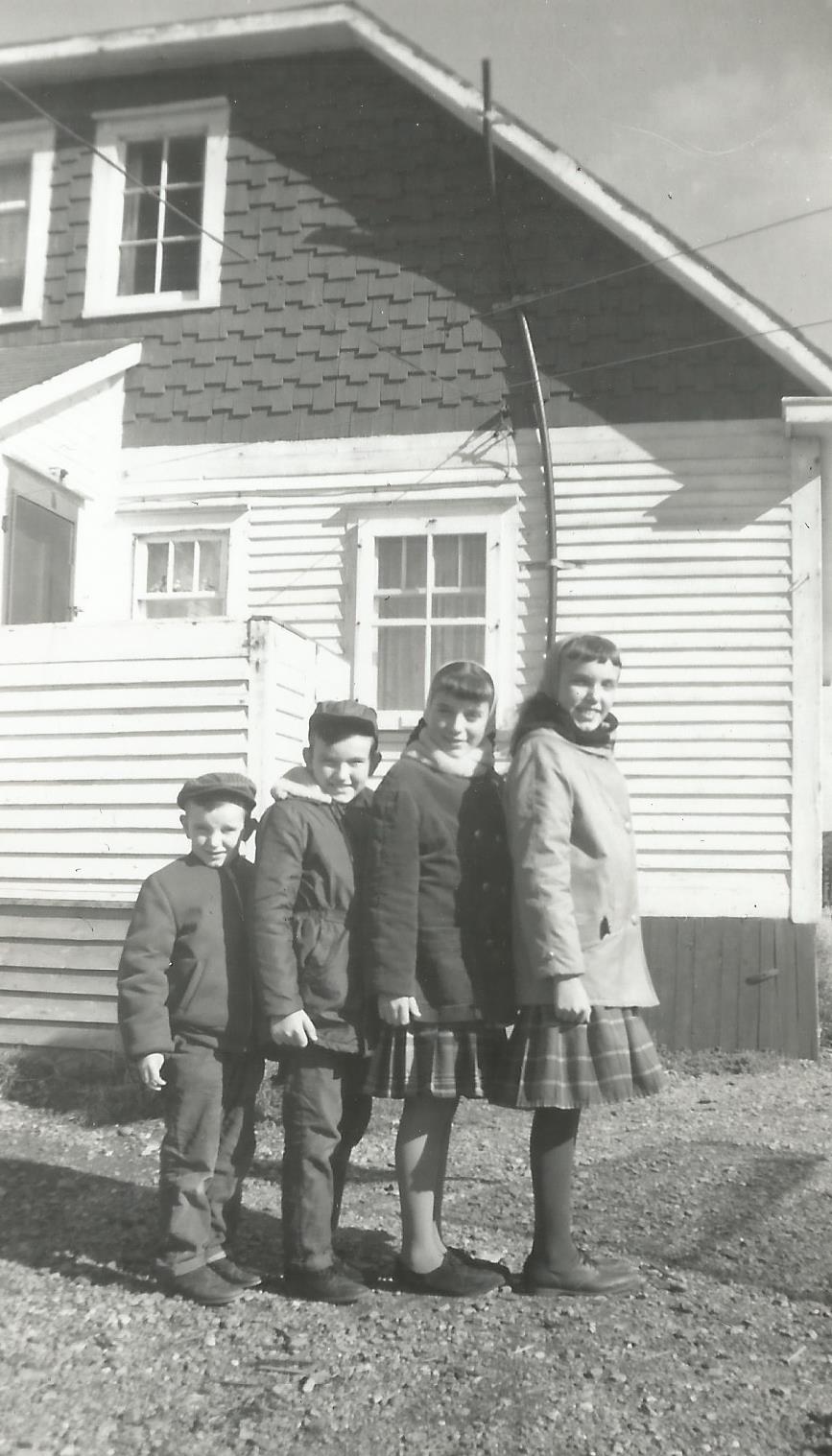
The Janes Four0009

One of the first things Sherry and I taught our children, once they were old enough to understand, was to never get in a vehicle with strangers. Our parents before us were no less conscientious in teaching us the identical directive. It was drilled into us–we drilled it into Krista and Christopher.

Thinking back on my own childhood, though, I wonder how well my siblings and I had learned the lesson our parents had so assiduously taught us.

When Dad was stationed in Twillingate as the Pentecostal pastor, we walked everywhere, even in winter blizzards–to the store, to church, to our friends’ yards, to school, to the post office. The primary reason was that Dad didn’t own a car. He owned a moped–which reached a maximum speed of 45 mph–but it would have been highly impractical for him to carry all four of his children to school on his bike. For one thing, it would take forever, as he could carry only one additional person, even if he wanted to.

One memorable morning in the dead of winter, the four of us left the parsonage to brave the elements to reach our respective schools. To get there, we had to cross a causeway.

The bridge was narrow. It was hazardous for two vehicles to attempt to pass, especially if there were people walking on it at the same time. One vehicle would stop and wait for the other to cross.

We Janes Four wended our way toward the bridge. As we neared it, we heard a vehicle approaching us from behind. We broke into single file. We and the car reached the bridge at the same moment. We hugged the right side. There must have been a vehicle on the bridge already, for the car behind us stopped abreast of us.

We younger siblings generally followed the dictates of the eldest. It must have entered Hope’s mind that the car had stopped for no other reason than to give us a lift to school. I don’t know if she thought about our parents’ command that we never get in vehicles with strangers. Perhaps she figured it was a parishioner who knew the pastor’s kids.

Whatever went through her mind, she stooped down and opened the back seat. “Come on,” she said as she climbed aboard. Not unlike the Brothers Grimm folktale of the Pied Piper of Hamelin, the remaining three siblings–Karen, David and yours truly–bundled in behind her.

Once we were seated as comfortably as possible, considering that the four of us were scrunched on the seat, we lifted our eyes. Staring back at us, with mouth agape, was the driver. The look on his face seemed to say, Who are you and why are you in my car?

At that moment, Hope must have read the same expression and realized that we had boarded a stranger’s vehicle. What to do? We could have exited as quickly as possible. Or, she could explain our presence. I don’t recall what she said, or if she said anything. But I suspect that she explained to the surprised driver exactly who we were and why we were in his car, “We thought you stopped for us.”

When the oncoming car passed us, our chauffeur transported us safely across the bridge and deposited us near one of the two schools. We disembarked and walked the rest of the way.

The Day the Recreational Food Fishery Opened

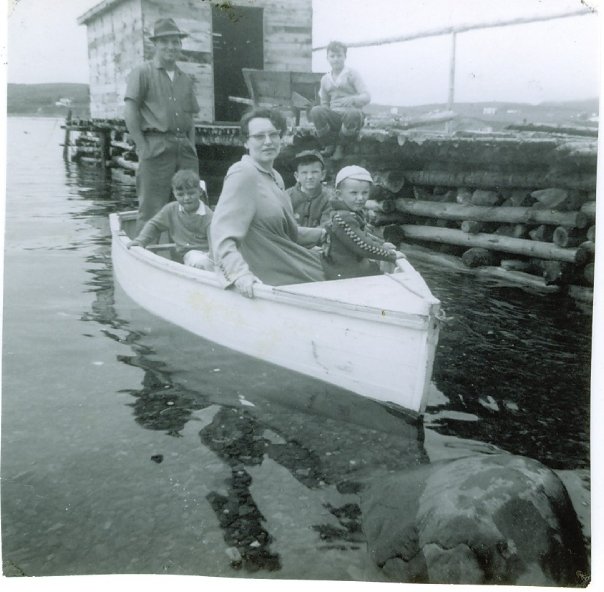
Sunnyside-Burton-boatSometime ago my sister Karen emailed me a photo I had never seen before. Five people are in a small boat, not far from a rickety wharf. A family friend is standing in the rear; my brother David is sitting behind me, & my mother is perched in the bow. I’m right there beside her.

Investigative research reveals that the snap was taken at Sunnyside between 1959 and 1963, closer to the latter year. I would have been about six.

Today I cannot help but wonder why I’m hanging on to the gunwales. Was I, even as a boy, scared of the water? I don’t know, as the finer details are lost in the mists of memory.

Thinking about my childhood boat ride brought to mind my one and only experience with the recreational food fishery.

I was ecstatic the day the fishery opened. My chance at a catch of codfish was well assured. Accordingly, I made plans with three buddies–Mel, Val and Dale–to try my luck.

In my haste, I did something I shouldn’t have done, and didn’t do what I should have done.

At three o’clock that morning, I drank a cup of coffee. But I shouldn’t have. I didn’t take Gravol. But I should have.

The early part of our expedition was pleasant and successful. I hooked a couple of cod. As my stomach began to churn, though, my enthusiasm for fishing began to wane. Still, I was too proud to admit defeat.

Did I mention that it was a wonderfully terrible day on the water? Our speedboat dipped into the boiling foam, hiding The Honourable John Efford’s vessel a hundred yards away, then rose on mountainous waves.

I knew that the coffee, which had tasted so delectable two hours earlier, was about to make a return visit. Stretching my head over the gunwale, I let nature take its course and relieved myself of the burning, burbling liquid.

The wrenching act did little to assuage my inner turmoil. My buddies–Job’s comforters all–muttered in unison, “Wuss!” Dictionary, please. Wuss…slang for a weak, timid and unmanly person. Val also commented on the green pallor of my face. I wasn’t sure if this was an extension of the Wuss comment or a modicum of sympathy.

Leaning over the gunwale again, I managed to say, “Your turn’s comin’!”

I no longer had the urge to drop my jigger into the depths. Nor did I want to augment my family’s meagre store of cod.

“I’m dyin’!” I gasped. “Get me to land.”

No verbal response, but a snicker or two. Then, “Can’t. Gotta get our quota, b’y. Can’t go in without all we’re ‘llowed to catch.”

Suddenly, Efford’s boat reappeared. Dale called over the crashing waves to the gentleman, “Got a sailor here wit’ no sea-legs.”

I felt like a Jonah. “Throw me overboard!” I suggested in a martyr’s voice. “Actually, my middle name is Jonah.”

As the waves increased in ferocity and the winds in velocity, my buddies finally realized just how sick I was. “We’ll go in,” the one at the motor promised.

“God bless you, my son,” I felt like saying. “Your confession has been accepted, and you’ve been absolved of all your sins. Heaven awaits you. Go and sin no more.”

I looked at Mel, certain my eyes were playing tricks on me. He was actually drinking a soft drink and eating a bag of chips and a chocolate bar. My golly! I thought. Ugh! Ugh! But there was nothing else down there to upheave.

We headed for land. Val was in the bow, still fishing. Suddenly, his face blanched. To my delight, as he pulled in yet another fish, he made his own initial contribution to the ocean.

Then, I heard an all-to-familiar sound behind me. Turning slowly, I saw Dale…prostrate on a thwart, his head hanging loosely over the gunwale. He too groaned as he divested the contents of his stomach into the roiling sea.

What could I say? I suppose I could have said, “I know what you’re going through.” I could have let bygones be bygones, and said, “Boys, I know what it feels like. Been there–got the stains on my coat to prove it. I pity you.” That would have been the Christian thing to do.

Naw! Instead, I exclaimed, “Looks good on you.” I wasn’t sure about the plural form of the word wuss, but I was too ill to care. “Wusses!” I chided.

They were too sick to respond, so I had the satisfaction of having the last word.

That night, I emceed a wedding. I got through it, but just barely. My pounding head and a rolling feeling reminded me of what friends had told me about a hangover. People later said to me, “Boy, did you ever look sick that night!”

If only they knew.

House Hunting in Ireland

journal2I dropped off some books at a second-hand bookstore. The owner promised to pay me, but not right then. “Come back later,” he said. I did, but received nothing. I could have taken my books back, but I tend to trust people until that trust is broken. So I patiently waited for a few dollars. One day, he said, “Take an armload of whatever I got on my shelves.” I didn’t need to be told twice.

Among what I brought home that day was an 80-page, handwritten journal, the dimensions of a legal size folder. I have derived hours of pleasure from reading what can best be described as a collection of “this ’n that.”

I often wonder about the original owner of this journal. Many questions arise in my mind: Why did he (or she) maintain a journal? Where did the writer live? Puddesters and Taylors are mentioned – do these names indicate a Cupids connection? I may never know the answers to my questions.

There are prayers, including Hank Snow’s “Prayer of a Horse,” which ends this way: “And finally, dear master, when my useful strength is gone, don’t turn me out to starve or freeze, or sell me to some cruel owner who will slowly starve and torture me to death. But do thou, my master, take my life in the kindest way you can, and your God will reward you here and after.”

For some reason, the year 1936 figures prominently in the journal, with lists of deaths, events, weather, disasters and fatalities in Newfoundland and elsewhere.

The reader learns how “Joyce’s sweater” and nine-year-old “Carson’s socks” were knit. There are instructions on how to make the popcorn, block, cable and lace point stitches.

Another entry records the sum of $7 being “paid to Doctor Cluny Macpherson per Miss White” on May 11, 1943. I wonder what service was rendered by this physician who, was born in St. John’s in 1879 and died in 1966.

Samuel Taylor, who serves with “Brother Churchill” on the Grand Lodge visiting committee, writes a Mr. Knight on March 19, 1944: “you can see by the dates of which we visited the hospitals that we didn’t have many calls, but we feel sure there were brothers of whom we weren’t notified of, but that’s not our fault.”

Robert E. Kelloway of the Carbonear Lodge is at the Grace Hospital in St. John’s. From April 26 to July 3, Taylor and Churchill bring him three dozen oranges.

Then Taylor and Churchill ask “to be relieved of this particular duty, as Brother Churchill isn’t able to get about very well and myself likewise.”

There are poems, plenty of them. Fully one half of the journal is given over to a cornucopia of poetry, including “Abdulla Bulbul Ameer,” “Marian Parker,” “Red River Valley,” and “Wise May Bring Their Learning.”

One poem begins: “He came to my desk with quivering lip; the lesson was done. ‘May I have a new sheet, dear teacher? I’ve spoiled this one.’ So I took his sheet all spoiled and blotted, and gave him a new one – all unspotted, then into his sad eyes smiled, ‘Do better now, my child.’ ”

Whoever maintained the journal obviously has a sense of humour, as is evident from the following story, “House Hunting in Ireland.”

“A couple, about to be married, were looking for a cottage and, after a lot of trouble, found one to suit them.

“On returning home, they were very quiet for a time, then the bride-to-be suddenly asked the prospective groom if he had noticed if there was a ‘W.C.’ to the house.

“He could not say so, so it was decided to write and ask the landlord.

“The landlord did not understand the term ‘W.C.’ and, after thinking a while, came to the conclusion that ‘W.C.’ meant ‘Wesley Chapel.’ So he answered as follows:

“ ‘Dear Sir:

“ ‘Very much regret the delay in the matter, but have much pleasure in informing you that the W.C. is situated nine miles from the house and is capable of seating 350 persons. This is very unfortunate if you are in the habit of going regularly, but no doubt you will be glad to know that a great number of people take their lunch and make a day of it, while others, who cannot spare the time, go by car and arrive just in time and are generally in too great a hurry to wait. The last time my wife and I were there was three years ago, and we had to stand all the time.

“ ‘Hoping this information will be of interest to you.

“ ‘I remain,

“ ‘Yours faithfully.’ ”

So perhaps the solemn days of yore weren’t all that mirthless after all.