There hangs on my wall a picture of an ice-fishing scene. I often look at it, as it holds great personal significance. It was a gift from my parishioners at a farewell party held for me when I left my pastorate in Labrador some years ago.
My friend, Jamie, whose name has been changed to protect the guilty, invited our family to join him and his family down at the lake for an overnight ice-fishing expedition. I’m not much of a fisherman, but I was determined to impress my family and friends with the biggest catch ever.
Out on the ice, a considerable distance from the cabin, Jamie and I made two holes. I stood over the hole I had made, my line dangling in the water, and patiently waited for a bite. What seemed like hours passed without a nibble. I felt discouraged.
Jamie walked over to me and helpfully suggested, “Leave the line in place and come back to the cabin for a mug-up.” Never one to ignore good advice and not thinking for a moment that his kind invitation had an ulterior motive, I jumped on his snowmobile with him and left my spot.
Throughout the meal, I said things like “I wonder if I got one yet. What if he’s so big that he breaks my line? What if he pulls it out of the hole and swims away?”
Unnoticed by me, Jamie left the cabin. Shortly after, I heard him shouting in the distance, “Tell Pastor Janes he caught a big one!”
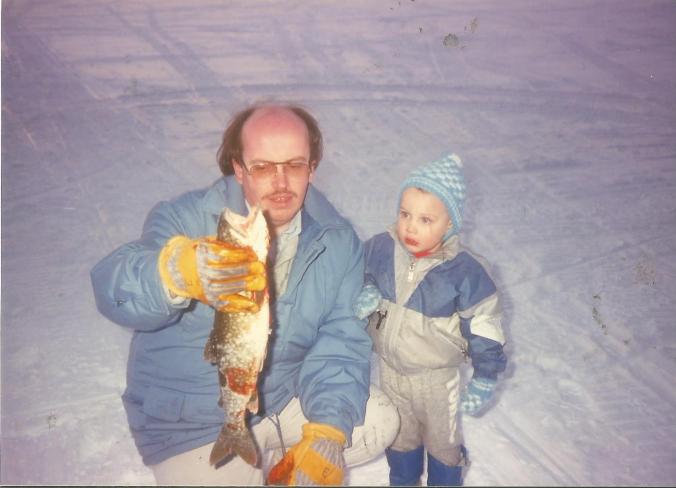
On this trip, my son Christopher and I did catch a fish. Here’s the evidence.
I jumped up from the table and dashed from the cabin. Tearing across the ice to my fish hole, I yelled, “How big is he?”
“He’s some big, Pastor, b’y!”
When I reached my fishing hole, Jamie passed me the line, saying, “Be careful. He’s a big one. Don’t let him get away. Tug gently on the line.”
I tugged on the line – it was taut. This had to be my champion fish.
Stooping down, I peered into the hole. All I could see was the unmistakable colour of a fish, responding only grudgingly to my tugging on the line. Of course, I was screaming and gesticulating by now, to let everybody back at the cabin know I had hooked a monster of a fish.
When I figured I finally had the champion beat out, I slowly began to rein him in. But what resistance I encountered! Then the object came abreast of the hole, but would come up no further. This encouraged me to shout even louder. “Jamie,” I called in panic, “I can’t get the fish up through the hole. Help me, b’y.”
As quick as a flash, he grabbed the line and began tugging at it with determination. Moments later, though, he exclaimed, “Pastor, b’y, the brick is too big to come up through the hole!”
The brick?
I stared at him in disbelief. When I turned toward the shore, there were all my family and friends, standing at the cabin window, laughing that Jamie had gotten me, but good.

 independently his ability as a translator. The jury members represented an impressive body of scholarship: Archibald Sayce (1845-1933), Flinders Petrie (1853-1942), James Henry Breasted (1865-1935), Arthur C. Mace (1874-1928), John Peters, Eduard Meyer (1855-1930) and Friedrich Wilhelm von Bissing (1873-1956). All of them were in practically uniform agreement that the meaning of the facsimiles’ hieroglyphics was completely different from Smith’s translation.
 Dad had spent four years in Bible school preparing for this? Appealing to his congregation for favourite hymns or choruses, he had been thinking in terms of selections chosen from the hymnal, not nursery rhymes! Not that he didn’t know “Mary Had a Little Lamb,” for he recalled it very well from his childhood. But as for being a parishioner’s choice of a chorus to be sung in a church service, well, it just didn’t seem appropriate. A litany of questions flashed into his mind, Where’s the spiritual content? How does it relate to God, to Jesus Christ, to the Holy Spirit, to the Church, to heaven? No, he decided, it doesn’t fit the bill. But how to handle the sincere woman’s unusual request?
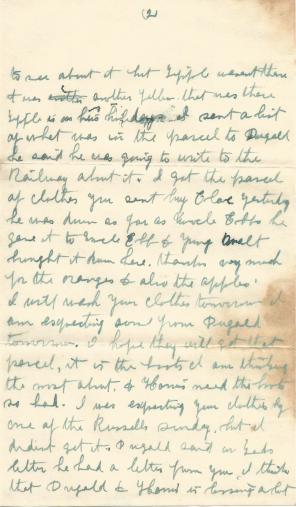 “I received your most welcome letter,” Tom began somewhat formally.
 Burton K Janes